

Thrombotic thrombocytopenic purpura (TTP) is a devastating disease with a downhill course of neurologic, renal and cardiac complications leading to death at a young age if untreated. Thrombocytopenia and thrombosis are its hallmark, with fever, anemia and neurologic deficits.
It is caused by large aggregates of vWF, a protein which is normally cleaved by ADAMTS13. In the presence of autoantibodies, activity of this protease is greatly diminished resulting in the formation of vWF multimers.. Caplacizumab prevents this pathologic aggregation. Approved in 2019 as Caplivi, it was the first nanobody to make it to patients.
Nanobodies have an interesting history dating back to the discovery of VHH antibodies in camelids in the mid-90s. Ablynx, a Belgian company, was the innovative biotech that recognized the potential of the small-size antibodies early on. They were aware that full-size mAbs have significant shortcomings related to size and target binding. For some diseases, conventional mAbs may not work as well as a nanobody.
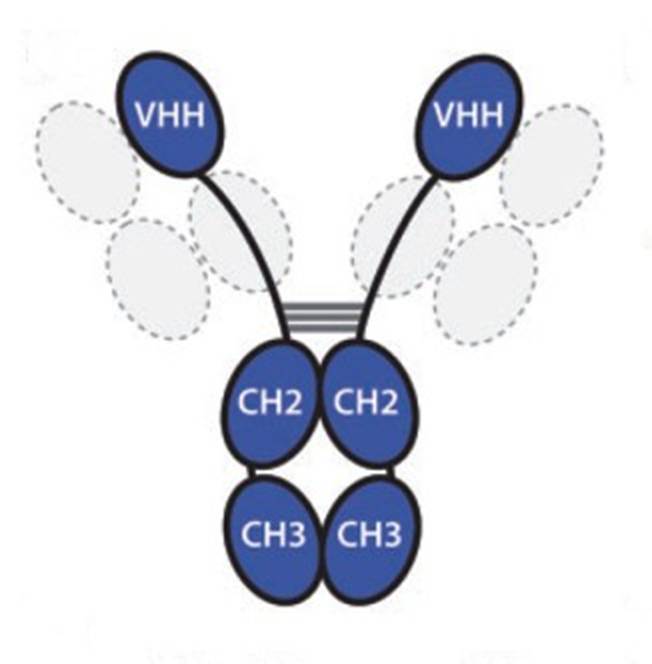
Figure 1: Camelid antibody without L-chains and without CH1 domain; the VHH segment is the basic building block for single domain nanobodies
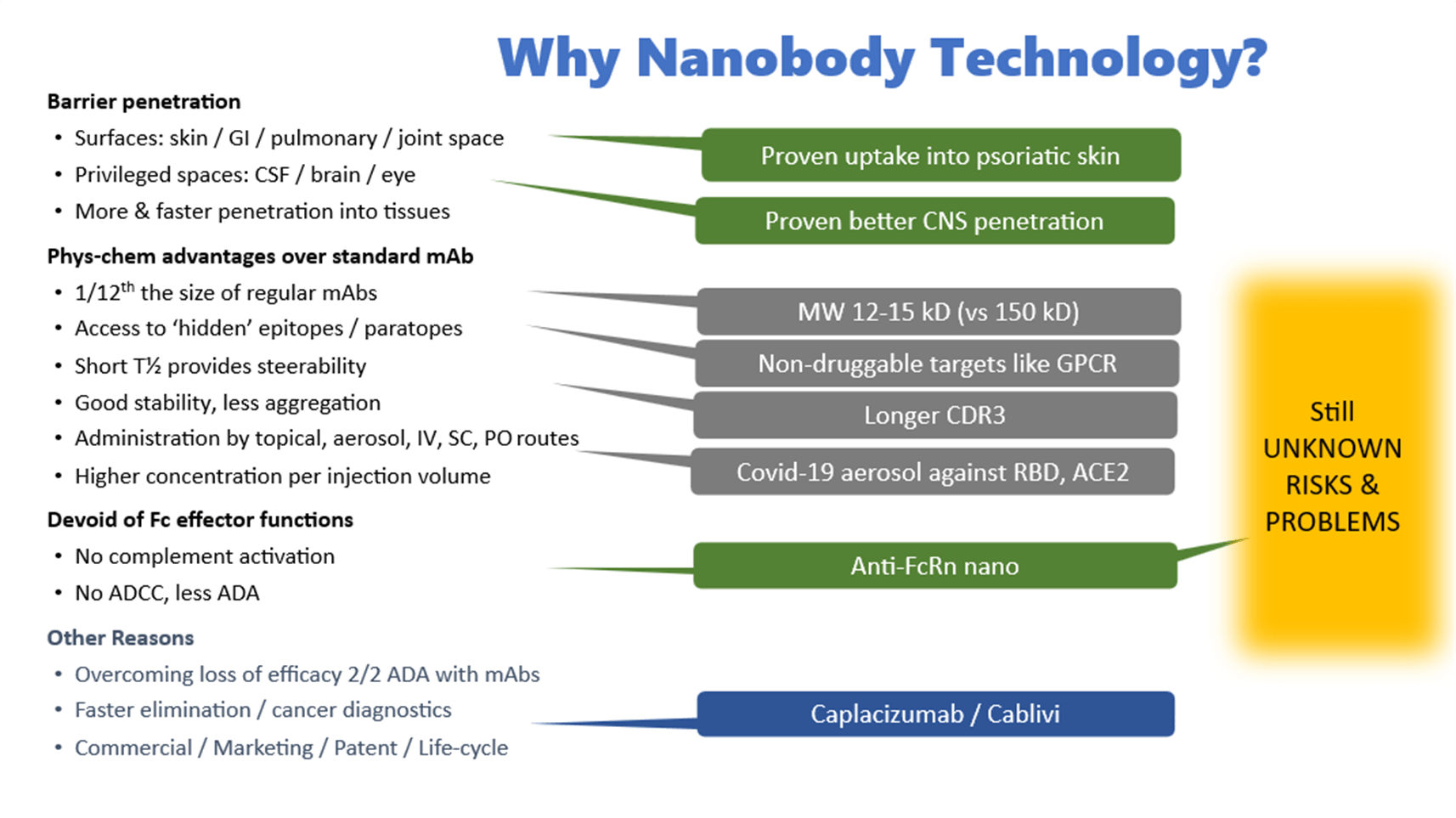
Here is a list of reasons to consider nanobodies:
Since then we have another FDA-approved nanobody construct: Ciltacabtagene Autoleucel (Carvykti) is a bivalent nanobody construct for the treatment of relapsed or refractory multiple myeloma. Several nanobodies for tumor diagnostics are also approved.
Given the list of differentiated features and properties, it would seem that nanos should find many uses in oncology and non-oncology indications. Despite this, biologicals such as ADCs, TCE and bispecific mAbs have stolen the show apparently. Most mAbs currently in development are standard IgG derivatives, with non-canonical formats as rare exceptions.
Most mAbs listed in the yearly update of The Antibody Society’s yearly review are for oncology indications. As nanos are among the smallest proteins capable of penetrating the tumor microenvironment, there is a now a significant uptick in numbers in development. A recent update and review of nanos in development for oncologic diseases is provided by DePauw et al.[1]
When we look at autoimmune diseases, nanos entering clinical Phases 1 to 3 are also increasing in numbers, but less than expected.
As of 2023, 8 nanos were in development for autoimmune diseases according to LeadGeneBio (psoriasis, Crohn’s, ulcerative colitis, spondylitis and other non-specified autoimmune diseases).[2] The list is certainly incomplete; nonetheless it makes the good point that companies develop nanos that are often derivatives of well-established therapeutics like TNFa inhibitors, IL-13 or IL-17 mAbs, or TSLP mAbs. In other words, these nanos are like repurposed mAbs: They represent derisked projects that have the benefit of established efficacy. As such, they are not really breaking new ground. One could therefore – perhaps cynically – say that these nanos are ‘me-toos’, offering minor improvements over existing mAbs, providing known mAb targeting in a nanobody format.
This, however, would be an unfair characterization. Let’s look more systematically at nanos in development that are breaking new ground, going where no mAbs have gone before.
In order to find these novel nanos, we studied the complete lists of mAbs in late stage development published by The Antibody Society.[3] Their latest tally includes 178 mAbs, with tables providing excellent target and format information.
Surprisingly, with only 2 exceptions, we do not see any nanos in development for non-cancer / non-diagnostic indications.
These exceptions are (1) sonelokimab, an IL-17 nano construct developed for PsA, psoriasis and HS, and (2) gefurulimab, a bi-specific nano with binding to complement C5 and albumin. Here the structures:

Figure 2: M1095 / Sonekinumab, a bispecific VHH construct. Ref.[4]

Figure 3: Gefurulimab, a bi-specific VHH construct. Ref [5]
Why so few nanos for autoimmune disease indications?
A short word about sonelokimab. This is a great bi-specific nano developed by Merck KG and and MoonLake. It is an IL-17A plus IL-17F blocker, connected to albumin to improve its half-life. In late clinical trials, it has shown excellent efficacy even in patients with hidradenitis suppurativa (HS), a tough challenge for any IL-17 or TNFa antibody. Once approved it will become clearer whether it can truly provide superior efficacy. As a late arrival to the market, it will be hard to beat the competition which is heating up. HS is a fairly common condition in the US: 1 in 250 adults are affected by some estimates [6]. Bimekizumab/Bimzelx, a full-size mAb targeting IL-17A / IL-17F just like sonelokimab, is already approved for HS, but its efficacy comes with a higher rate of oral candidiasis. Secukinumab/Cosentyx just garnered FDA approval for HS as well.
Back to nanos in development for autoimmune diseases. The Antibody Society list is woefully incomplete. Alexander et al. published what we believe is a more up-to-date and more comprehensive review of nanobodies in development [7]. For non-onc indications, the authors list nanos for infectious diseases like SARS/Covid, HIV, HBV, RSV and other viruses; the MoA being block of surface receptors or neutralization of antitoxins. The stability of nanos is a favorable and desired feature, esp.with aerosolized use for the prophylaxis (and treatment?) of viral respiratory infections.
More interesting is the use of nanos in neurologic diseases. Brain penetration cannot be achieved with full-size mAbs unless there is a leaky BBB. Otherwise it would be hard to explain the CNS findings in Alzheimer studies with aducanumab and lecanemab. There is also some evidence that secukinumab may be able to penetrate the CSF based on results in RRMS. Used with the transferrin shuttle, better CNS levels can possibly be achieved. These studies are still at very early stages but AD, PD, and ALS are neurodegenerative diseases with significant immune components; nanos could potentially revolutionize the field of neurology.
For autoimmune diseases, most development work is still centered on the tried-and-true: mimicking the efficacy of TNFα, interleukin and lymphokine blockers, often as dual nanos for combined receptor interaction. This seems advantageous for scientific, PK, and other reasons – after all, combining standard mAbs would be prohibitively expensive.
Looking for the rise of nanobodies in AI in the years ahead, esp. in neurology
H REINHART MD
NOTE:”Nobody” is a trademarks of Ablynx, now a Sanofi company
ABBREVIATIONS
ACE2 angiotensin converting enzyme 2
AD Alzheimer’s disease
ADA anti-drug antibody
ADAMTS13 von Willebrand factor-cleaving protease
ADC antibody-drug conjugate
ADCC antibody-dependent cellular cytotoxicity
AI autoimmune (disease) – not artificial intelligence!
ALS amyotrophic lateral sclerosis
BBB blood-brain barrier
CDR complementarity determining region
CNS central nervous system
CSF cerebrospinal fluid
GPCR G-protein coupled receptor
HS hidradenitis suppurativa
PD Parkinson’s disease
RBD receptor-binding domain / Covid
RRMS recurrent/relapsing multiple sclerosis
RSV respiratory syncytial virus
TCE T-cell engager
TSLP thymic stromal lymphopoietin
TTP thrombotic thrombocytopenic purpura
VHH variable piece of heavy chain of camelid antibody
vWF von Willebrand factor
REFERENCES
[1] DePauw T. Current status and future expectations of nanobodies in oncology trials. Expert Opinion Investigational Drugs, 32:, 705, 2023
[2] https://www.leadgenebio.com/scientific_knowledge/detail/nanobodies_2024_en
[3] Crescioli S. Antibodies to watch in 2025. MABS 2025, 17: 2443538. https://doi.org/10.1080/19420862.2024.2443538
[4] Svecova D. A randomized, double-blind, placebo-controlled phase 1 study of multiple ascending doses of subcutaneous M1095, an anti–interleukin 17A/F nanobody, in moderate-to-severe psoriasis. J Am Acad Dermatol 81, : 196, 2019
[5] Jindal S. Characterization of the bispecific VHH antibody gefurulimab (ALXN1720) targeting complement component 5, and designed for low volume subcutaneous administration. Mol Immunol 165: 29, 2024
[6] Jifri A. Prevalence of Hidradenitis Suppurativa. A Systematic Review and Meta-regression Analysis. JAMA Dermatol 2021;157:924
[7] Alexander E. Discovery of nanobodies: a comprehensive review of their applications and potential over the past five years. J Nanobiotechnol 2024; 22:661
