
Earlier this year, the NEJM published interim data on atacicept and sibeprenlimab in IgAN, both well-designed Phase 3 pivotal registration trials of promising drugs [1],[2]. Sponsors were clearly anxious to show the world how well their drug is working, but why publish interim results? After all, IA data are usually not the last word on efficacy and can be misleading.
Well, the situation is slightly different for IgAN. there is really no doubt anymore that APRIL or BAFF/APRIL inhibitors have efficacy in this disease. All compounds from this class have shown in aggregate that significant IgA lowering is achievable, with concomitant reduction in proteinuria. There is also considerable evidence of benefit regarding the underlying disease. Even if these drugs do not stop the gradual loss of kidney function, they can change the downhill trajectory considerably. Nobody will expect a reversal of damage already done.
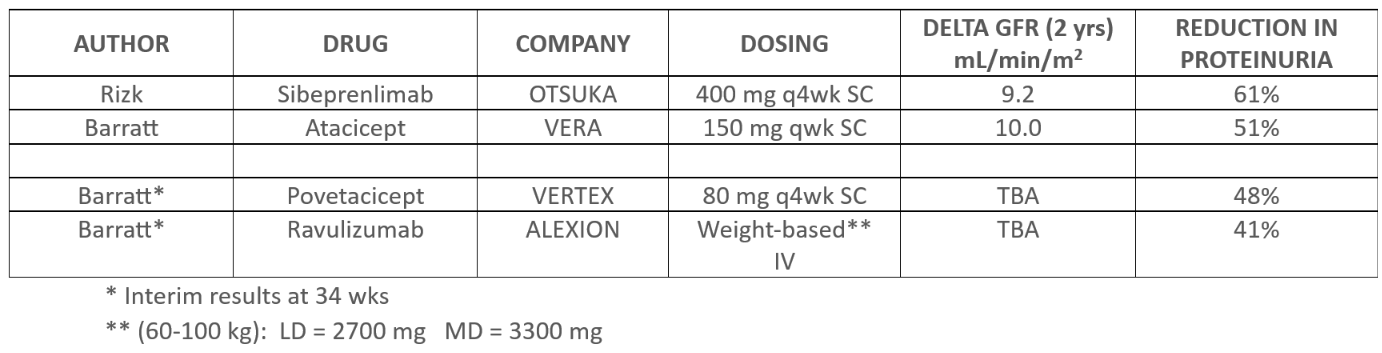
Now the definitive data are in. Final results of large Phase 3 BAFF/APRIL inhibitor studies were published in the NEJM for sibeprenlimab (APRIL inhibitor) and atacicept (BAFF/APRIL inhibitor) both showing stabilization of eGFR, the all-important FDA approval criterium.[3],[4] In the same issue interim results for povetacicept (BAFF/APRIL inhibitor) and ravulizumab (C5a complement inhibitor) are presented as well; both showing impressive reductions in urinary albumin loss (see below).[5],[6]
All these studies were conducted with guidance of eminent nephrologists. We are treated to a barrage (we are tempted to call it a Barrattage!) of surprisingly similar outcomes:
The enthusiasm is almost palpable; a new era is dawning for IgAN patients who only had RAAS and SGLT2 therapy for disease control until recently. The IgAN market is new territory and underserved; competition will be fierce. This is great news for patients and caregivers.
With great efficacy and safety results, we will soon leave the clinical arena behind, entering commercial territory. What differentiation is there, if any?
In line with prior data, ravulizumab was very well tolerated over the first 34 wks; it seems that the infection risk (esp. meningococcal) can be managed with prior vaccinations. IV dosing though every 2 months will probably not become the preferred option for CKD patients. Weight-based dosing, however, should not be a problem. The proposed dose regimen is sufficient to achieve C5 blockade through the entire 2-month period, with excellent efficacy.
It appears that many different complement inhibitors can claim efficacy in IgAN. This includes
- iptacopan, an oral factor B inhibitor with not so stellar results in IgAN (see PI)
- cemdisiran, an RNAi drug in Phase 3, administered SC q4wk targeting C5, with good results on proteinuria in a small Phase 2 trial[7]
- C3 inhibitors
- The MASP-2 inhibitor narsoplimab was discontinued, because efficacy over placebo could not be established.[8]
Is there a need for BAFF inhibition when APRIL blocking delivers the same efficacy? Belimumab, a pure BAFF inhibitor, has a positive effect on proteinuria, albeit to a lesser degree than seen with BAFF/APRIL or pure APRIL inhibitors.[9]
Sibeprenlimab did just as well as the dual antagonists to the point of stopping disease progression. Quite impressive, I’d say.
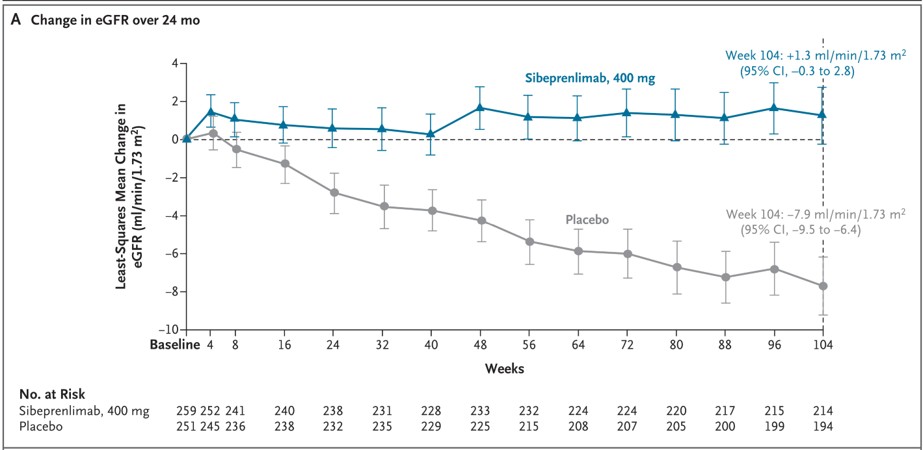
Figure 1: From: Rizk – NEJM 2026
Lacking other differentiating features, dosing convenience and price will become major drivers of market share: povetacicept and sibeprenlimab are q4wk SC drugs, atacicept is administered qwk SC. But these are not the only determinants of commercial success; the marketing muscle of Big Pharma needs to be factored in as well.
IgA nephropathy was a disease without therapy 20 years ago.[10] It was considered a rather indolent disease with slow progression towards ESRD. Textbooks, however, mention that some cases progress more rapidly, that abnormal galactosidation (or the lack thereof) referred to as Gd-IgA1 is found uniformly, and that IgA deposition on the glomerular membrane sets in motion a series of events (simplistically referred to as the 4-Hit Hypothesis) that seem to trigger glomerular damage resulting in proteinuria .
It is now clear that APRIL inhibitors (on top of optimized ACE/ARB/SGLT2 therapy) can buy time. In the next few years long-term f/u data will be generated. Then we will learn how much dialysis can be postponed or avoided altogether. On this, the jury is still out. But the advent of so many new therapeutics will drive awareness of the disease at rather early stages, with treatment being offered for some 30-40 yrs to come as most patients are young – middle age. It will be the next big gold mine for Pharmas unless CMMS, NICE or other gatekeepers step up their cost-control efforts.
In this context, you may be curious to learn more about telitacicept, a drug already approved for IgAN in China (and various other indications). Results of telitacicept studies in IgAN have been published and show comparable efficacy to other ‘tacicepts’.[14]
An internet search informs us that NRDL reimbursement for Telitacicept, a SC weekly injection, was RMB 2,586 (approximately USD 395) per shot at launch, but it is now reimbursed at just RMB 778 per 80 mg shot. National insurance covers only approx. 70-80% of total drug cost, the remainder falls on the patient. This amounts to approx. USD 10k annually paid by insurance, and an extra USD 2-3k out of pocket paid by the patient for a 160 mg/wk dosing regimen. However, half that dose seems to work well too, bringing costs down for insurers and individuals. Remember, the prevalence of IgAN is much higher in China and SEA than in Western countries.[11]
That said, you can safely assume premium pricing in the USA where the disease is less prevalent and drug costs uncontrolled. Hence, the WAC of sibeprenlimab/VOYXACT comes in at approx. USD 390k annually.[12] For iptacopan/FABHALTA, the WAC is in the same range: approx. USD 550k annually.[13]
Questions about the longer-term efficacy and safety of these drugs will be addressable in a few years, after market introduction. It’s anyone’s guess, but biologicals are usually quite safe.
As a next step, we would like to get away from injectables and have more oral options. Iptacopan is an oral drug and has good efficacy/safety data. What about an oral complement C5a receptor blocker? Something like avacopan, but with qd oral dosing and without liver toxicity, which would be really nice to have.
Companies like chronic diseases that require life-long symptomatic treatments. There is nothing wrong with palliative therapy when RAAS is the only alternative. But we really need more research on the etiologic / causative triggers that lead to Gd-IgA1 formation if this is, indeed, the trigger for IgAN.
The research advances in the last 2 decades are impressive; in another 20 years the IgAN chapter will be rewritten completely. We hope for a curative intervention.
ABBREVIATIONS
ACE angiotensin-converting enzyme
APRIL a proliferation-inducing ligand
ARB angiotensin-receptor blocker
BAFF B-cell activating factor
CKD chronic kidney disease
eGFR estimated glomerular filtration rate
IA interim analysis
IgAN IgA nephropathy
LD loading dose
MD maintenance dose
NRDL National reimbursement drug list / China
PI package insert
RAAS renin-angiotensin-aldosterone system (ACE/ARB)
SGLT2 sodium-glucose transport 2 inhibitor
TBA to be announced
WAC wholesale acquisition cost
REFERENCES
[1] Lafayette R. A Phase 3 Trial of Atacicept in Patients with IgA Nephropathy. NEJM 2026;394: 647
[2] Perkovic V. Sibeprenlimab in IgA Nephropathy — Interim Analysis of a Phase 3 Trial. NEJM 2026;394: 635
[3] Barratt J . Atacicept in IgA Nephropathy — Phase 3 Trial Final Efficacy Analysis. NEJM 2026 DOI: 10.1056/NEJMoa2610103
[4] Rizk D. Sibeprenlimab in IgA Nephropathy — Final Phase 3 Trial Analysis. NEJM 2026 DOI: 10.1056/NEJMoa2609127
[5] Barratt J. Ravulizumab in IgA Nephropathy — Interim Analysis of a Phase 3 Trial. NEJM 2026 DOI: 10.1056/NEJMoa2607544
[6] Barratt J. Interim Analysis of a Phase 3 Trial of Povetacicept in IgA Nephropathy. NEJM 2026 DOI: 10.1056/NEJMoa2608682
[7] Barratt, J. Phase 2 Trial of Cemdisiran in Adult Patients with IgA Nephropathy: A Randomized Controlled Trial. Clin J Am Soc Nephrol 2024 19:452
[8] Mo B. Efficacy and safety of complement inhibitors in IgAN: a systematic review and meta‑analysis. International Urology Nephrology (2026) 58:201
[9] Wu M. Efficacy and safety of belimumab in IgA nephropathy: real-world experience. Nephrol Dial Transplant 2026,
[10] Faull R. Chapter 61: Immunoglobulin A Nephropathy and Henoch-Schönlein Purpura. In: Schrier, Diseases of the Kidney & Urinary Tract. 2007 Philadelphia: Wolters Kluwer Health / Lippincott Williams and Wilkins.
[11] https://search.brave.com/ask?q=elaborate&conversation=09bbfae4ea5a2b60a4497f811488e1686c48 (accessed 10/26/2026)
[12] https://search.brave.com/ask?q=price+of+Voyxact+in+US&conversation=09bbb2782f476707876d98ebc94ed9862532 (accessed 10/26/2026)
[13] https://search.brave.com/search?q=price+of+Fabhalta+in+US&conversation=09bb973b37f73109e8133349e5ef34cbb3c2 (accessed 10/26/2026)
[14] Lv J. Telitacicept for IgA Nephropathy — Interim Analysis of a Phase 3 Trial. N Engl J Med 2026;394:1916
