
 You may be aware of recent food product recalls associated with food poisoning due to listeria contamination: ready-to-eat products, deli meats, sandwiches, protein snacks, chicken, turkey, cheese and dairy products. The list is long as Listeria is ubiquitous in the environment. One can find it in meat and milk/cheese products mainly, but it does not end there, as recent outbreaks testify. Sometimes it’s blueberries, sometimes contaminated lettuce, celery or hummus, your favorite Middle Eastern dish. This list keeps getting longer. [1]
Here is a graphic that shows food recalls over the past 10 years for the 3 main pathogens:
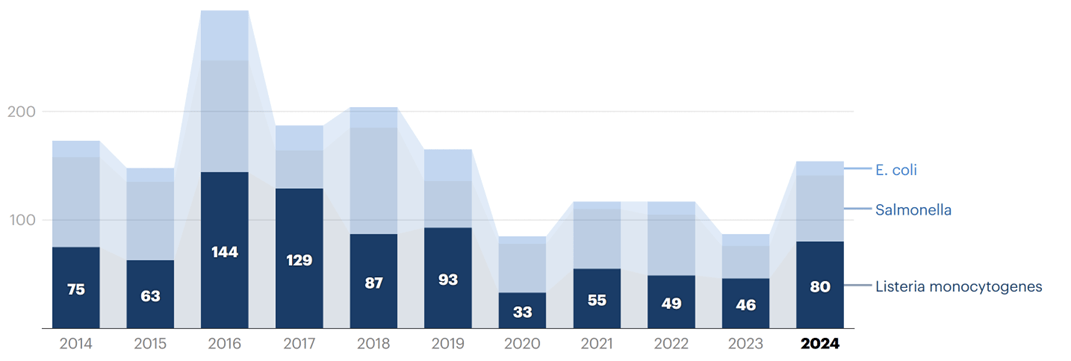
Figure 1: From Ref. [2]
For 2025, a similar picture emerges. As of August, according to the Food Recall Reporter, we had 33 recalls of products just in the US due to Listeria contamination [3]. This website details food recalls not only by pathogen but also by Recall Class which is defined as:
Class I: Most serious, involving products that may seriously harm or kill a consumer.
Class II: Potential health hazard with a remote probability of adverse health consequences.
Class III: Products that may pose a risk to specific (but not all) consumers.
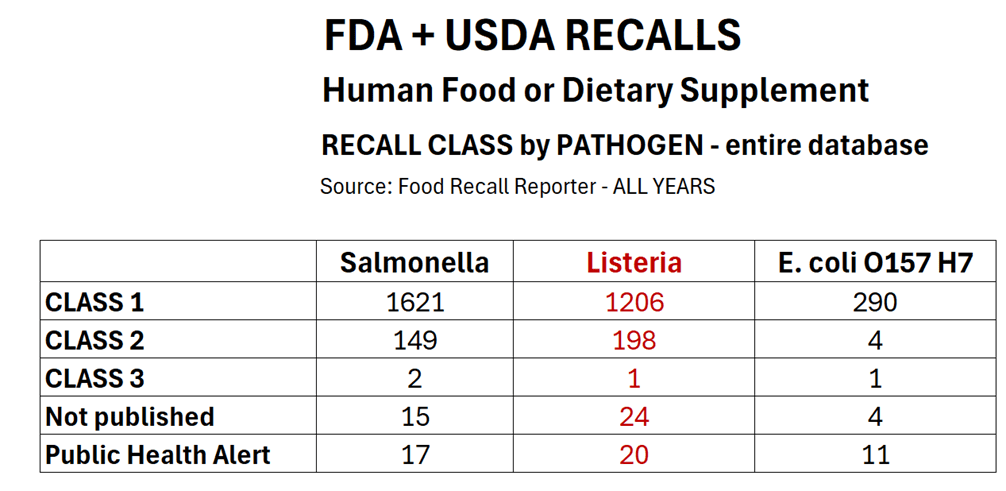
Of all the recalls due to bacterial contamination found in this extensive database, Salmonella and Listeria were by far the leading offenders. Most recalls were in the most serious Class 1 category. The number of actual outbreaks is not searchable in Food Recall Reporter but actual outbreaks are presumably less frequent than the number of Public Health Alerts.
Listeria infection is a reportable disease. Despite so many recalls and the high prevalence of the organism in veterinary medicine and food products, outbreaks are rather infrequent. Telling by the recent literature, it seems that veterinarians are studying the organism more than clinicians who see relatively few infections caused by Listeria monocytogenes, because we have infection control measures in place that prevent transmission with a very high degree of success.
Listeria is a pathogen that commands respect. It is associated with higher mortality than Salmonella infection. When bloodstream infections occur in immunocompromised patients, the mortality is very high even with appropriate antibiotic therapy (30-40%). The CDC estimates that listeriosis is the third leading cause of death from foodborne illnesses with about 260 deaths per year.[4], [5]
It demonstrates some really effective and novel ways of overcoming host barriers and defense systems.
Listeriosis, as is often stated, is an infection of the very young, pregnant women, older persons and those with significant immune defects. Isolation from patients often comes as a surprise. A call from the micro lab about a variable gram-positive organism, with tumbling motility may be the first hint that we are dealing with this pathogen. Hopefully, there will be no second call from the micro lab telling us about an unanticipated resistance pattern.
The latest and 10th edition of Mandell’s PPID[6] still lists ampicillin and gentamicin as the antibiotics of choice. This is correct now but may not be so much longer.
In veterinary medicine, isolates resistant to multiple antibiotics have almost routinely been found. By now, most L. monocytogenes strains are tetracycline, cephalosporin, and quinolone resistant. The frequent presence of resistance to disinfectants and metal ions would seem to be the result of wide-spread indiscriminate antibiotic use in farming and veterinary practice. Chromosomal and plasmid-mediated resistance, efflux pumps and other mechanisms make Listeria an MDR pathogen and more capable invader.[7] Resistance to meropenem, aminoglycosides and trimethoprim, antibiotics often used in the clinic, are particularly of concern [8], [9]. Plasmids encoding resistance to chloramphenicol, clindamycin, erythromycin, streptomycin, and tetracycline have been documented.[10]
It stands to reason that MDR isolates found in food sources will eventually be seen in human cases as well.
It is hard to find susceptibility data on clinical isolates from the USA. While the literature is replete with data from China to Iran, Brazil to Russia, amazingly little is published about the antibiogram of listeria from US patients and outbreaks. Unfortunately, the last 10-year report on ‘Foodborne Illness in the US’ is from 2019, and it does not provide susceptibility information.5
Here is our take on the Listeria landscape, a mix of known facts and a few new insights:
- Listeria has evolved in a most elegant way to avoid the immune system:
We don’t know of any other bacterial pathogen that so successfully bypasses the immune system. Listeria has its own adhesion ligands (IntA + IntB), is not opsonized by IgA in the gut, and survives inside a cell’s phagosome. It thrives in the cytoplasm of infected cells, replicating with incredible speed (1 cycle each hour). It travels, propelled by a comet tail formed by cellular actin polymers [11], from cell to cell thus bypassing recognition by the adaptive immune system (see Figure).
- Virulence mechanisms range from resistance to gastric acidity, tolerance of low temperatures and high salt concentrations to biofilm formation. Listeria can survive in a viable but non-culturable (VBNC) ‘Zombie’ state, remaining dormant to ‘Kill Another Day’.
- Listeria can cross all kinds of barriers: the gut, the placenta, even the BBB.
- Listeria is developing resistance to more and more antibiotic classes. This may not be fully appreciated by clinicians but is well documented in food processing and veterinary literature.
- To the best of our knowledge, there are no new antibiotics with Listeria activity in development. Phage therapy for human listeriosis is not availablek, but phage cocktails are on the market for reducing bacterial titers in food products.[12][13] Efforts to develop vaccines for humans and animals are ongoing [14].

This blog is dedicated to my microbiology teacher, Prof. Heinz P. R. Seeliger.
And yes, Listeria seeligeri was named after him…
ABBREVIATIONS
BBB Blood – brain – barrier
IntA, Int B internalin A, B
LLO Listeriolysin O
PPID Principles and Practice of Infectious Diseases
VBNC viable but non-culturable
REFERENCES
[1] Toit S. Exploring the genetic variability, virulence factors, andantibiotic resistance of Listeria monocytogenes from freshproduce, ready-to-eat hummus, and food-processing environments J. Food Sci. 2024;89:6916
[2] https://www.consumeraffairs.com/news/bacteria-food-recalls-reach-five-year-high-in-2024-123024.html Accessed Sept. 2, 2025
[3] https://www.foodindustrycounsel.com/ Accessed Sept. 2, 2025
[4] https://www.cdc.gov/listeria/hcp/clinical-overview/index.html Accessed Sept. 2, 2025
[5] Scallan Walter E. Foodborne Illness Acquired in the United States—Major Pathogens, 2019. Emerging Infect Dis. 31, April 2025. https://wwwnc.cdc.gov/EID/article/31/4/24-0913_article Accessed Sept. 2, 2025
[6] Mandell, Douglas, and Bennett’s Principles and Practice of Infectious Diseases. 10th edition Elsevier 2025
[7] Angelidis A. Prevalence, Serotypes, Antimicrobial Resistance and Biofilm-Forming Ability of Listeria monocytogenes Isolated from Bulk-Tank Bovine Milk in Northern Greece. Pathogens 2023, 12, 837 https://doi.org/10.3390/pathogens12060837
[8] Mohapatra R. Recurring food source‐based Listeria outbreaks in the United States: An unsolved puzzle of concern? Health Sci. Rep. 2024;7:e1863. https://doi.org/10.1002/hsr2.1863
[9] Luque-Sastre L. Antimicrobial Resistance in Listeria Species. 2018. Antimicrobial resistance in Listeria species. Microbiol Spectrum 6(4):ARBA-0031-2017.
doi:10.1128/microbiolspec.ARBA-0031-201
[10] Koopmans M. Human Listeriosis. Clin Microbiol Rev 2023, 36:1
[11] Actin comet tails are also used by Shigella flexneri for intracellular propulsion
[12] Hyle K. Recent Advances in the Application of Bacteriophages against Common Foodborne Pathogens. Antibiotics 11: 1536, 2022
[13] Tariq, U., (2024) “Using bacteriophages to assure food safety: A natural and effective tool to combat foodborne pathogens”, BioScientist: The Salford Biomedicine Society Magazine 1(6). doi: https://doi.org/10.57898/bioscientist.244
[14] Phelps C. A listeriolysin O Subunit Vaccine is Protective Against Listeria monocytogenes. Vaccine. 2020; 38: 5803
