

A ton is a tonne, by any other name. A tonne, also called a metric tonne, is the equivalent of 1,000 kg. There are also imperial tonnes and long tonnes which have a slightly different conversion factor: 1 tonne of either is equivalent to 1.01604691 metric tonnes.
The amount of antibiotics used worldwide per year for veterinary purposes is about 100,000 tonnes. This is a lot of drug, even by Mexican cartel standards. Here is a little math:
- The Atlantic Ocean contains 310,410,900 km3, or 310,411 m6 or 310.4 x 10⁹ L of water [1]
- 100 million kg of antibiotics equals 108 kg, or 1011 grams
- Now, let’s put all of this into the Atlantic (please note, we only add 1 year’s worth of production!) …
…and we get 1011 / 310.4 x 10⁹ [g/L] or 100/310.4 or 0.322 g/L (or 322 mg/L)
Some doomsayers may think that this level of pollution is quite high. Others would point out all of the biodegradation pathways that inactivate, oxidize, bind, and ultimately break down these antibiotics in the environment. As these are mostly tetracyclines, we have to be concerned with accumulation in soil and water, because these compounds do not biodegrade easily in nature [2]. The worst offenders are probably the quinolone class of antibiotics for which neither UV light nor biological means of degradation seem to be effective. Only the rare tree fungus Gloeophyllum striatum was found capable of breaking down ciprofloxacin somewhat after prolonged exposure.[3]
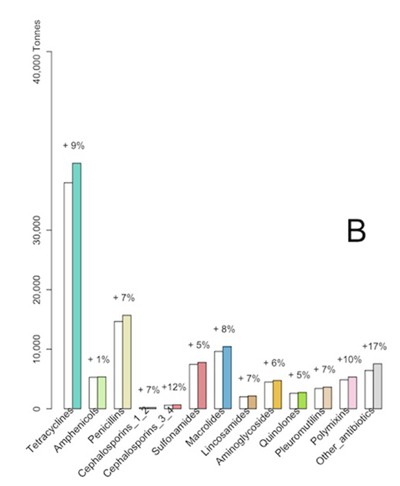
In a recent article by the group of von Boekel from the Health Geography and Policy Group ETH Zurich [4], an overview was provided of world-wide veterinary use of antibiotics. They break it down by anti-infective class, food animal (cattle, sheep, pigs, chicken), and geography, using sophisticated modelling of trends and future use.
The authors set the stage by reminding us that protein from animal sources is an important staple and in high demand. Therefore, the veterinary use of antibiotics is meant not only for treatment, but more for prevention and ‘growth promotion’. There are different philosophies at work regarding antibiotic use in food animals: while EU countries are more inclined to avoid antibiotics altogether to avoid selection of resistance, the US and many other nations have been reluctant to follow this path. Instead, they believe in monitoring antimicrobial susceptibility of isolates from food sources.
There are no uniform reporting requirements for veterinary use of antibiotics. Data are difficult to assemble and interpret given the disparate sources, ways of reporting data, and many other impediments to analysis. Needless to say, this is purposeful obfuscation on a grand scheme. As stated in the article, Brazil—the largest meat exporter in the world—still largely lacks a legal framework for antimicrobial use.
Here are a few interesting facts that we rarely hear mentioned in the clinic when debating ‘antibiotic stewardship’:
- In 2017, antimicrobial use (AMU) in animals represented 73% of all antimicrobials given worldwide.
In other words, 3x more antibiotics (in tonnes or kg) are being used for veterinary purposes than doctors prescribe for patients in human medicine. - In 2020, global AMU (tonnes) in the cattle, sheep, chicken, and pig industry was estimated at 99,502 tonnes of active ingredient (95% CI: 68,535–193,052).
These CI ranges are very large and reflect our level of ignorance. From an article published in 2023 we would have expected that the 2020 data would be more precise. - Based on current trends, global AMU was projected to increase by 8.0% to 107,472 tonnes (95% CI: 75,927–202,661) by 2030.
We learn what antibiotic manufacturers already know: antibiotics are a growth market for years to come.
- Veterinary use by antibiotic class:
- tetracyclines are most common, followed by penicillins, macrolides, and sulfonamides. Older antibiotics like aminoglycosides and amphenicols still find use, albeit to a lesser degree.
- With the exception of quinolones, newer antibiotic classes like 3rd generation cephalosporins are not given often to food animals.
- In contrast, pleuromutilins had a long history in veterinary medicine before becoming part of the human antibiotic portfolio.
- China banned the veterinary use of polymyxin in 2018.
- Veterinary use by country and region:
- Asia (China and India) is using antibiotics much more than the Americas; amazingly little consumption was reported from African nations.
The latter may be an artifactual underreporting from countries that do not provide sufficient or reliable statistics. - In 2020, China, Brazil, India, and the United States remain the top 5 countries for absolute AMU in tonnes.
- Asia (China and India) is using antibiotics much more than the Americas; amazingly little consumption was reported from African nations.
 We leave it to our readers to draw their own conclusions. As antibiotic stewardship only applies to clinical medicine and only to 25% of total production, stewardship should be extended to veterinary medicine as well. It’s like paying a lot of attention to secure the front door when leaving back doors and windows wide open.
European countries – and more recently China – have made significant strides in reducing or eliminating antibiotics in food animals. These are major steps in the right direction; some countries are becoming serious about protecting the environment from antibiotic pollution and preventing AMR.
ABBREVIATIONS
AMR antimicrobial resistance
AMU antimicrobial use
CI confidence interval
REFERRENCES
[1] https://iere.org/how-many-gallons-is-the-atlantic-ocean/#Understanding_the_Magnitude. Accessed Sept. 11, 2025
[2] Li Q. Microbial Degradation of Tetracycline Antibiotics: Mechanisms and Environmental Implications. J. Agric. Food Chem. 2024, 72, 13523
[3] Wetzstein H. Degradation of the Fluoroquinolone Enrofloxacin by the Brown Rot Fungus Gloeophyllum striatum: Identification of Metabolites. Applied Environment Microbiol, 1997, 63: 4272
[4] Mulchandani R. Global trends in antimicrobial use in food-producing animals: 2020 to 2030. PLOS Glob Public Health 3(2): e0001305. https://doi.org/10.1371/journal.pgph.0001305
Please also visit our previous post on this subject from 2015 at https://allphasepharma.com/dir/2015/12/07/2174/food-for-thought-sprinkled-with-small-amounts-of-antibiotic-residues/
