

We have to thank Liu and colleagues for a thorough review of pharmaceutical development activities in China and elsewhere during the last decade.[1] The authors reviewed a total of 34,844 Phase 1-3 trials, showing a significant uptick in studies initiated by Chinese companies. Compared to 2015, trial numbers have steadily increased worldwide; as can be seen in Figure 1, this increase came disproportionally from China.
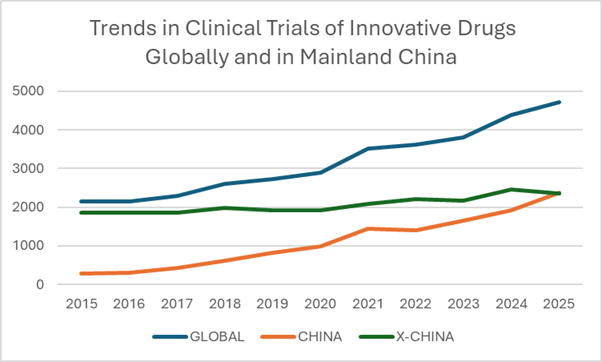
The authors also looked at specifics, the stage of research and the focus of innovation that occurred in China.
Not surprisingly, most trials in China are Phase 1 trials; at this early stage, foreign companies make good use of China’s CRO capacities. The decision to outsource is always made based on quality, cost, and regulatory considerations at a particular site that could impact study start-up. With quality much better than in former years and a more flexible regulatory mindset, China has become an attractive place to conduct clinical research. However, in a competitive world, with everything else being equal, costs are a major decision criterium, even for Phase 1. While the price of studies, ie, per patient cost, is still lower in China than in most other regions, the gap favoring Chinese sites is diminishing. In our estimate, clinical services in China no longer come at a bargain price.
So long as there still is a cost differential, it will attract Big Pharma. No wonder Australia ranks high for Phase 1 work with their low costs. Even Chinese companies like to start their programs in Australia as it offers tax incentives and efficient regulatory review.
The reverse is true for Phase 3 studies which are still mainly conducted outside of China in countries targeted for future marketing. This is clearly borne out by the Liu data analysis. Rarely do Chinese companies venture abroad; most of their programs stay in China, especially early-on. Hence, Phase 3 trials in China are conducted with China as a participant, not as the main contributor, in most cases.
This will eventually change. It makes economic sense for China and other SEA countries to take on a leadership role especially when diseases are more prevalent in that part of the world. Consider IgAN, a disease more common in Asia. With several compounds vying for patients to enroll in Phase 3 trials, it would seem foolish to skip Chinese centers. Likewise, MDR acinetobacter infections are much more rare in the West than in the East; therefore, it is imperative to involve high-prevalence areas like China for Phase 3.
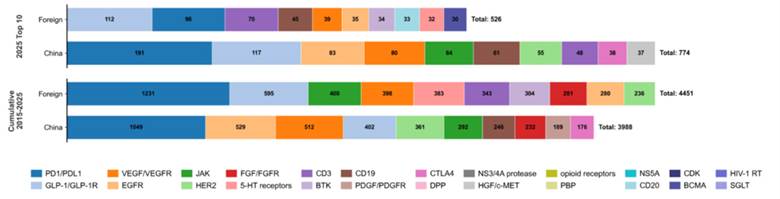
Like most R&D worldwide, clinical trials in China are dominated by oncology compounds coming from well-established target areas: PD-1, BTK, JAK, EGF, etc. There is a big push into mAbs, bispecifics and ADCs. Liu calls it a ‘fast-follower mentality’, an assessment that accurately reflects the past 10 years.
This is bound to change in the next decade. We believe that research leadership will translate into more innovation coming from within China, gradually driving clinical programs away from established targets towards greater innovation. The research output and excellence of top universities in Shanghai (Fudan) and Beijing (Tsinghua) is nothing short of extraordinary; these institutions and others in China will spearhead a pipeline of new drug candidates to be tested and validated with or without foreign help.
As we mentioned in a prior blog, the China market for pharmaceuticals is still held hostage by the lack of investments of the magnitude required at later stages of clinical development.[8] The China market is also more controlled than most foreign investors realize. We know of several examples of drugs that are blockbusters in the US, EU and Japan but barely profitable in China after passing NRDL cost controls.
For now, this relegates Chinese research output to a supplier function for pharmaceutical companies that have a need to bolster their dwindling pipeline, face a patent cliff, or encounter market pressures from generics and regulatory price erosion.
As long as the China market for novel pharmaceuticals does not create conditions for profitability of its own industry and within its own borders, we have an export-oriented research-based industry there. Hence, unless this situation changes in the future, China’s pharmas will have to provide drug candidates primarily to the outside world, supporting their portfolio mainly with royalties and partnerships with Big Pharma. This is what most Chinese start-ups are striving to achieve, with few exceptions.
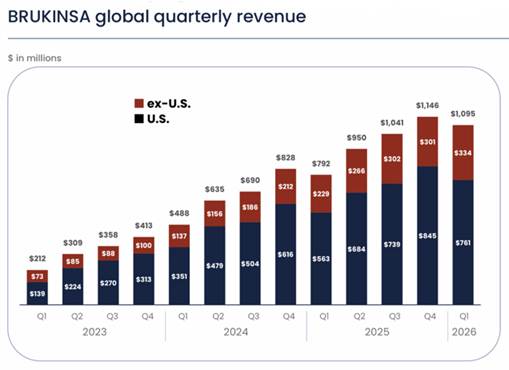
Revenues for Brukinsa, BeiGene / BeOne’s flagship BTK inhibitor are 75% US-based [2], and those for Vyvgart, the FcRn inhibitor from Argenx, are approx. 10x higher than in China.
The list price for Legend Biotech’s Carvykti, a BCMA-directed CAR-T injectable for refractory MM is $465k-$593k in the US [3]. It is currently the most expensive drug that money can buy. The NRDL price in China is $80k-140k but may be as low as $55k [7] . For Europe we find a range of prices, all higher than in China, with the notable exception of Turkey [3],[4],[5],[7]:
- UK from $130,000
- Israel from $100,000
- Spain from $430,000
- Turkey from $55,000
- Germany launch price: €420k, reimbursement price: €285k.
A word about the ‘Top Ten’ areas of engagement for Chinese companies in 2025 and why we are optimistic about the ‘next decade’.
According to Liu et al. 774 trials (36%) fit established categories and targets as mentioned in Figure 3. The remaining trial activity, 64% in total, targets other more innovative receptors or other MoAs. Even if we assume that most of these trials are at an early exploratory stage, this constitutes a remarkably broad endeavor. For foreign trials, innovation currently stands at 78%.
China R&D and clinical development have demonstrated major progress in just 10 years and stand to steam ahead. The groundwork for success is in place, it looks like exciting times are coming!
ABBREVIATIONS
ADC Antibody-drug conjugate
BTK Bruton tyrosine kinase
IgAN IgA nephropathy
JAK Janus kinase
MDR Multi-drug resistant
NRDL National Reimbursement Drug List
REFERENCES
[1] Liu S. Trends in the landscape of clinical trials of innovative drugs in China since 2015. Nature Reviews Drug Discovery 2026, 25: 412
[2] BeOne Q1 2026 results Q1 2026 Results (accessed 6/29/2026)
[3] https://healtheh.com/blog/carvykti-price (accessed 6/29/2026)
[4] ATMPs in Germany – Carvykti® :: Ecker Ecker (accessed 6/29/2026)
[5] https://us-uk.bookimed.com/article/car-t-cell-therapy-cost/ (accessed 6/29/2026)
[6] Liu S. Trends in the landscape of clinical trials of innovative drugs in China since 2015. Supplementary information. https://doi.org/10.1038/d41573-026-00081-x
[7] https://www.placidway.com/article/5039/Cost-of-CAR-T-Therapy-China-vs-US-vs-Europe
[8] https://allphasepharma.com/dir/2026/01/06/6036/the-economist-on-china-pharma-going-global/
